


The following bandwidth of Sify in office-wise is required to complete CSI Rollout
1-2 System Office -512Kbps
3-5 System Office - 1Mbps
more than 6 System Office - 2 to 8 Mbps


 Posts
All Comments
Posts
All Comments
The following bandwidth of Sify in office-wise is required to complete CSI Rollout
1-2 System Office -512Kbps
3-5 System Office - 1Mbps
more than 6 System Office - 2 to 8 Mbps
Please find F & A CSI User Manual Prepared by Me for our colleague to help in work into CSI platform..
Name - Kumod Waikos
Profession- System Administrator
Place- Chalisgaon HO-424101
No. D-11011/36/2016- DBT (Cab.)
Govt. of India
Cabinet Secretariat
DBT Mission
Subject: Aadhaar linking and interoperability of General Provident Fund (GPF), Public Provident Fund (PPF) and Employees’ Provident Fund (EFF) accounts regarding.
A meeting was held under the chairmanship of Joint Secretary, DBT Mission, Cabinet Secretariat on 25th August, 2017 at 11:00 A.M in the Conference Hall, 4th floor, Shjvaji Stadium Annexe Building, Rajiv Chowk, New Delhi on the subject mentioned above. The list of participants isplaced at Annexure I.
2. Joint Secretary, DBT Mission welcomed the participants and stated that the objective of the meeting is to deliberate on Aadhaar linking of GPF, PPF and EPF accounts of employees, examine the possibility of a centralised repository of employees" fund details with Aadhaar as the primary identifier and establishing portability of fund accounts across organisations. He requested all stakeholders to share comments and suggestions in this regard.
3. Deputy CGA, Govt. Banking Arrangements, D/o Expenditure informed that an on-line salary application system, Employee Information System (EIS) is being developed within PF MS for implementation in all Drawing and Disbursing Offices (DDOS) and Pay Accounts Offices (PAOS) of Central Ministries. EIS is envisaged to be a central repository of details of all salaried employees, and it can also maintain details of GPF of government employees. He fiirther stated that at present, Aadhaar number is not a mandatory field in employee information records, due to which Aadhaar seeding may be low. it was discussed that if the employee data on E13 are linked with Aad’naar, it may serve the purpose of establishing interoperability of salary and GPF accounts across DDOs. It was highlighted that Railways and Defence departments are not covered under £18. An example of e-Samarth was cited, which is a centralised database of CRPP (Central Reserve Police Force) in MHA, which may be studied for this purpose. Dy CGA also mentioned that M/o Railways and Defence may also be consulted in this context.
4. Senior Audit Officer, Office of Comptroller & Auditor General (CAG) of India, Delhi stated that at present, State AG (Auditor General) offices assign new GPF numbers to employees while moving across different FAQs and there is no centralized mapping system with Aadhaar as the primary identifier. JS. DBT Mission requested that the matter may be taken up with the Office of C&AG, with the concerned Dy C&AG to examine the possibility of mapping all State GPF subscribers across the country. It was suggested that the role of a third party such as NSDL to create and maintain this database may also be examined.
5. Assistant Director, D/o Posts stated that that presently, around 25 lakh PPF accounts out of 27.2 lakh accounts are on Core Banking Solution (CBS) network and these accounts are portable across Post Offices. It was informed that every PPF account is associated with a PPF number and a Customer Identification Form (CIF) number, which is a unique number that holds all personal as well as account related information of the customer. ideally, a customer can have one CIF number in one post office. though the customer can have multiple accounts under these numbers. It was further informed that Aadhaar linking with individual accounts and CIF numbers is being undertaken and 4.7 crore ClFs out of total 56 crore CIFs (which also include savings certificates, term deposit accounts, etc) have been seeded with Aadhaar. JS, DBT pointed out that Aadhaar seeding is very low in this case, and the Department may undertake necessary actions to expedite the same to achieve 100% seeding by December 31, 2017. It was further suggested that all PPF accounts and CIF numbers may be linked with Aadhaar and the Department may share its suggestions on establishing a common repository of all PPF accounts using Aadhaar as the identifier.
6. Deputy Director, M/o Labour & Employment stated the Universal Account Number (UAN) provides portability for the employees covered under EPF. It was informed that 14 crore out of 4 crore active subscribers’ records have been seeded with Aadhaar. It was discussed that this will enable portability of EPF accounts when the details of Bank Account, Aadhaar and PAN are seeded in UAN database of the employees and are verified by employer on change of job. It was suggested that Aadhaar seeding of all may be taken up priority.
7. Deputy Secretary, Budget, D/o Economic Affairs stated that a host of small saving schemes including PPF are Operated by post offices, public sector banks and select private secror banks and Aadhaar seeding is being undertaken in all these accounts. JS, DBT Mission enquired if the. Department is taking any initiative to have a centralised platform for all savings schemes, given that all banks use different systems and Operate in silos. It was discussed that the Department may examine the matter and share updates in this regard.
8. After detailed deliberations, the following were agreed upon.
i. All stakeholder Departments to ensure 100% Aadhaar seeding of GPF, PPF and EPF accounts by December 31, 2017.
ii. All Departments to examine the possibility of developing common platforms for their respective service subscribers/employees/account holders using Aadhaar as the unique identifier to ensure portability across the financial system.
iii. DBT Mission to hold a review meeting with senior officers of all stakeholder Departments in the second week of September. 2017 to discuss the issue further.
Annexure-I
List of Participants
1. Shri Peeyush Kumar, Joint Secretary, DBT Mission, Cabinet Secretariat-in Chair
2. Shri Amn Shanna, Director, DBT Mission, Cabinet Secretariat
3. Shri Neeraj Kumar Sharma, Deputy CGA, Govt. Banking Arrangements. D/o Expenditure
4. Ms. AnjanaVashishtha, Deputy Secretary, D/o Economic Affairs
5. Shri Dinesh Dharni, Deputy Director, M/o Labour & Employment
6. Shri Vijay Kumar Kanojia, Senior Audit Officer, Office of Comptroller & Auditor General of India
7. Dr.Ajinkya Kale, Assistant Director General, D/o Posts
8. Ms Disha Pannu, Assistant Director General, D/o Posts
9. Ms.Tulsipriya Rajkumari, Assistant Director, DBT Mission, Cabinet Secretariat
10. Ms. Jaya Kurnari, Assistant Audit Officer, Office of Comptroller & Auditor General of India
11. Shri Kamlesh, Assistant Audit Officer, Office of Comptroller & Auditor General of India
****
No. D-11011/36/2016-DBT (Cab.)
Government of India
Cabinet Secretariat
DBT Mission
4th Floor, Shivaji Stadium Annexe
Rajiv Chowk, New Delhi- 110001
Dated: 29th August, 2017
Subject: Aadhaar linking and interoperability of General Provident Fund (GPF), Public Provident Fund (PPF) and Employees’ Provident Fund (EPF) accounts-regarding.
The undersigned is directed to forward herewith a copy of record of discussion of the meeting held under the chairmanship of Joint Secretary, DBT Mission, Cabinet Secretariat on 25.08.2017 at 11.00 AM on the subject mentioned above for information and further necessary action, please.
Sd/-
(Tulsipriya Rajkumari)
Assistant Director
DBT Mission
*****
Employees' Provident Fund Organisation
(Ministry of Labour, Govt. of India)
Head Office
Bhavishya Nidhi Bhawan, 14- Bhikaiji Cama Place, New Delhi - 110066
(CENTRAL ANALYSIS & INTELLIGENCE UNIT)
No.CAIU/011(44)2016/Aadhar/10273
Date: 22.09.2017
To
All ACCs (Zones) including ACC (ASD),
All RPFC-I/ RPFC 11 (Regional Offices),
Sub:- Aadhaar linking and interoperability of General Provident Fund (GPF), Public Provident Fund (PPF) and Employees’ Provident Fund (EPF) -regarding.
Sir,
Please find enclosed herewith a letter No.D-11011/36/2016-DBT (Cab.) dated 29.08.2017 received from Assistant Director, Cabinet Secretariat, DBT Mission forwarding therewith record of discussions of the meeting held under the Chairmanship of Joint Secretary, DBT Mission on 25.08.2017, wherein it has been directed that all the Departments should ensure 100% of Aadhaar seeding by December 31,2017.
2. It is requested to implement the instructions issued by the Cabinet Secretariat, DBT Mission, New Delhi for seeding of Aadhaar by December 31, 2017.
[This issues with the approval of ACC-II (CAIU)].
Yours faithfully,
Encl: As above
(A.K. Mandal)
Regional P. F. Commissioner-I(CAIU)
Volumetric Weight:
1. Wherever the postage, tariff or charges are fixed for a postal article based on weight , the weight shall mean the gross or the volumetric weight whichever is more.
2. Gross Weight: Gross weight is the weight shown by a standard weighing scale. When the Article is appropriately placed on to or suspended from the said scale.
3. Volumetric Weight: volumetric weight of the article shall be arrived at from the volume of that article using the appropriate formulae.
4. Exception: Volumetric weight need not be determined in following cases.
(a) If the sum of the length, breadth and height is not more than 90 centimeters, and any of the dimensions is not more than 60 centimeters.
(b) In case of an article is in roll form (Cylindrical) if the length and diameter each are less than 90 centimeters.
These exceptions will also applicable to Speed Post article.
5. *Procedure for calculation of volume:* Measure each dimension in centimeters rounded off to next higher centimeter.
(a) (i) *Cuboids* (e.g. square or Rectangular): Its Dimensions means length, Breadth and height.
(ii) *Cylindrical rolls:* Dimensions means diameter of its circular base and length.
(b) *Articles other than above shapes should not be accepted*
(c) *Formula for calculation of volumetric weight*
(i) Cuboids (e.g. Square, Rectangular)
Volume = Length X Breadth X Height
(ii) Cylindrical Roll.
Volume = 0.785 X (Diameter of Circular base)2 X Length
The Volume so arrived at in cubic centimeters should be rounded off to the next higher whole number.
6. *Formula to calculate volumetric weight: When the volume is calculated in cubic centimeters, the formula to determine the volumetric weight in kilograms shall be*
*Volumetric Weight in Kilo Gram = (Volume in Centimeters)3 ÷ 6000*
Volumetric weight so arrived at shall be rounded off to the next higher kilogram.
7. Postage or tariff or charges for the Postal articles shall be determined with reference to weight i.e. gross weight or volumetric weight, whichever is more.
8. Postage/Tariff charts for all kinds of postal articles may be worked out beyond the corresponding weight (as in gross weight) limits for calculation of due postage/Tariff.
9. The maximum weight and size limits for different kinds of postal articles are prescribed in Clause 100, 124, 125, 128(2), 129(2), 132, 137(d) and (e), 146(1) and (2) of Post Office Guide Part-I.
(DG Posts letter number 8-9/2007-D Dt. 16/2/09 and 4/3/09 and letter number 51-04/2009-BD & MD Dt. 24/3/09)
A DOZEN hefty wooden crates sit outside a small factory on the outskirts of Lucknow, the capital of India’s most populous state, Uttar Pradesh. On the shop floor inside, where chattering machines bag and package herbal teas, a manager explains what will happen when he opens the crates. “His job will go,” he says, nodding at one boiler-suited operator. “And his over there, and that one’s too.”
Improved technology has already boosted the firm’s output fivefold since its launch in 2002, with no increase in staff. The new machines in the crates, which require a single operator rather than three, will double it again. But the manager insists that, as in the past, he will somehow find jobs for everyone—as drivers or even watchmen if necessary.
Few Indian workers have such conscientious employers. They do, however, increasingly face similar risks of redundancy, or of failing to find a decent job in the first place. A big part of the challenge stems from automation. According to McKinsey, a consulting firm, machines could eliminate some 52% of India’s jobs if current technology were adopted across the board. This affects not only manufacturing. For the first time in nearly a decade, India’s high-flying IT industry this year laid off thousands of workers. A survey of private-sector workers by the Economic Times, an Indian daily, found 62% agreeing that their job prospects were shrinking.
India’s labour force will soon overtake China as the world’s largest, but the country is struggling to generate opportunities for a workforce with the wrong skills. Slowing economic growth, a decline in investment rates, the shock of economic reforms, a long-term decline in agricultural employment and a faulty education system have combined to reduce the proportion of Indians who hold proper jobs.
India is also in the midst of a demographic transition, as birth rates fall. The share of the population that is of working age is peaking relative to the share of children and old people. That should, as long as jobs are available, lift the rate of economic growth. Yet the proportion of working-age people actually in work has been falling steadily (see chart). India, home to a sixth of humanity, is in danger of forfeiting its “demographic dividend”.
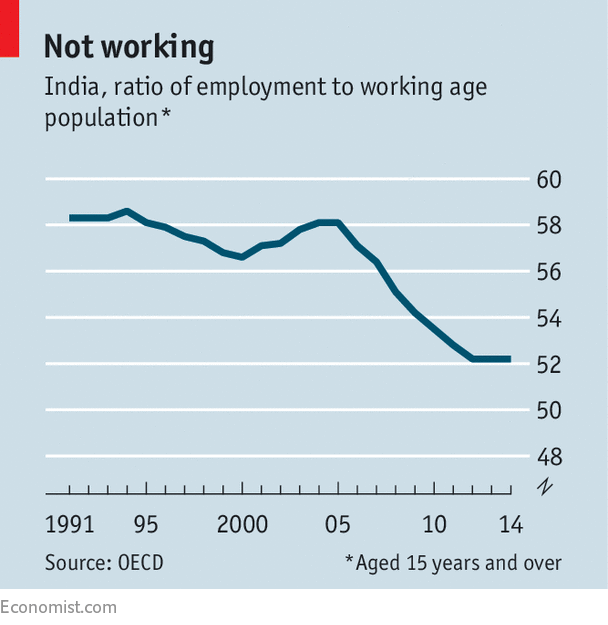
The numbers are daunting. Just to keep unemployment in check, India needs to create some 10m-12m jobs a year. When economic growth is strong, it has just been able to do that: the government’s Labour Bureau estimates that from 2013 to 2015 the economy added 11m jobs a year. A slowdown in the prior two-year period, however, had kept job growth at half that level, leaving a shortfall of 10m jobs. The tipping point seems to be economic growth of about 7%. Ominously, growth has steadily slowed since 2016; in the quarter ending in June it fell to 5.7%, although transitory factors may have played a part in that.
The data on jobs are also unreliable. Officially, India’s jobless rate has hovered at an enviable 4% for many years. But the government is generous in its definition of work. By its own admission, some 35% of workers in 2015—the most recent year for which in-depth surveys are available—had held a job for less than 11 months in the previous year. According to the World Bank, over 30% of Indians between the ages of 15 and 29 are NEETs, “not in education, employment or training”.
This may be an exaggeration. In a country where some 86% of workers are reckoned to be in “informal” employment—ie untaxed and without a contract—counting can be difficult. But the pressure for jobs is real. Last year thousands of Jats, a community in northern India that traditionally owned small farms but has become increasingly urbanised, rioted to press demands for an expanded quota of government jobs. The unrest left 25 dead and briefly severed the main water supply to Delhi, India’s capital. Other castes and ethnic groups have taken similar action in recent years, in the same hope of strong-arming their way into jobs.
Successive Indian governments have tried to tackle the dearth of employment. One massive state program, the world’s largest, doles out millions of temporary make-work jobs in rural areas. The current government has also tried to boost skills. Last year its National Skill Development Corporation trained some 557,000 workers. By its own count, however, only 12% of these trainees found jobs. The central government has also promised to clarify India’s dauntingly complex labour rules: it says it will streamline compliance, and shrink some 44 different labour statutes into four simpler bundles.
The rules are indeed onerous. In many states, firms with more than 100 employees must seek government approval to fire a single worker. As a result, many resort to contractors to fill their payrolls with temporary hires, a solution that evades red tape but produces neither dedicated staff nor a happy workplace. Other companies simply choose to stay small: some 98.6% of non-farm businesses have fewer than 10 workers. This carries a long-term cost in productivity. Indian garment-makers, for example, tend to be tiny. Small wonder that competitors in such countries as Vietnam and Bangladesh, where giant factories are plugged into global supply chains, now far outpace India in exports.
India’s biggest industrial firms have found yet another solution. Surprisingly for a relatively poor country, their factories tend be more capital-intensive than those of their counterparts in China. For example, at a sprawling site outside the southern city of Chennai run by Hyundai, a South Korean firm, some 8,500 workers toil alongside 530 robots. The fully digitised facility turned out 661,000 cars last year, one every 72 seconds. It ranks second in productivity and quality among the firm’s 34 factories around the world; its engine plant is number one. “What we have here is an integrated cascade between suppliers and the assembly line,” says Ganesh Mani, the vice-president for production, “The entire ecosystem has to be in sync.”
Not all Indian workplaces can hope for such efficiency. But if the government does not do more to boost growth and to tip the balance between hiring people and installing robots, the jobs crunch will grow ever more severe. The problem requires not tinkering at the edges, but a concerted effort to put India’s economic ecosystem—from underfunded and poorly run schools, to a hopelessly clogged legal system, to ensnaring webs of red tape, to overburdened infrastructure—in sync.
Source : https://www.economist.com


